
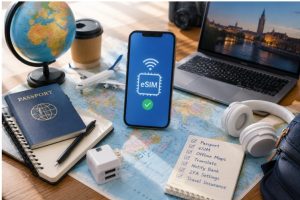
Studying abroad is one of the most formative experiences available to American university students. A semester in Madrid, a year in Tokyo, a summer programme in Cape Town: the academic, cultural, and personal growth that comes from genuine immersion in another country cannot be replicated in a classroom at home. But between packing your laptop and downloading Google Translate, there is one practical detail that almost every first-time study abroad student handles badly in the first week: mobile connectivity.
This guide covers everything you need to know about staying connected internationally as a student, from understanding your options to setting everything up before you board.
Why Your US Phone Plan Will Not Work as Expected
Most American university students are on family plans with AT&T, Verizon, or T-Mobile. These plans work flawlessly in the United States. The moment you land in London, Paris, Seoul, or Sydney, the economics change significantly.
AT&T’s International Day Pass charges $12 per day for data access in most international destinations. Verizon’s TravelPass runs $10 per day. T-Mobile includes free international data on Magenta plans but throttles speeds to 128 kbps, which is slower than a 3G connection from fifteen years ago. At 128 kbps, loading Google Maps takes several seconds per screen, uploading a photo to Instagram requires patience, and video calls are practically unusable.
The T-Mobile speed cap is the detail that catches most study abroad students off guard. Free international data sounds like the perfect solution until you discover that it is functionally inadequate for the way you actually use your phone. A semester abroad at the throttled speed is not a realistic option.
For students on AT&T or Verizon, the daily charges add up with alarming speed. A semester is approximately 120 days. At $10 to $12 per day, that is $1,200 to $1,440 in data charges on top of your regular monthly bill. No student budget absorbs that comfortably.
Understanding Your Options
You have three realistic approaches to mobile connectivity abroad, and which one fits depends on the length and structure of your stay.
The first option is a local SIM card purchased in your destination country. Prepaid tourist SIMs are available at airports and phone shops in virtually every country, typically offering several gigabytes or unlimited data for the equivalent of $15 to $40 per month. This is the most cost-effective option for a full semester stay. The trade-offs are practical: you need to remove your US SIM and store it safely, your US phone number becomes unreachable, and SMS-based two-factor authentication codes sent to your American number stop arriving. For students who use their US number for bank verification, this can cause access problems at the worst possible times.
The second option is a travel eSIM activated before departure. Understanding what an esim is matters here: Holafly explains the technology clearly, but the practical summary is that an eSIM is a digital SIM built into your phone that activates via QR code without removing your physical US SIM. Both lines run simultaneously. Your US number stays active for calls, texts, and verification codes. The eSIM handles data on local networks at local rates.
The third option is relying entirely on WiFi. Most study abroad housing, university campuses, and cafes provide WiFi. This works adequately for stationary tasks but fails the moment you leave your accommodation without a data connection: navigating an unfamiliar city, translating signs, calling for help in an emergency, or finding the address of a medical facility.
The eSIM Setup for Study Abroad Students
The eSIM is the option that most experienced study abroad advisors and returning students recommend for the first weeks abroad, regardless of what long-term SIM strategy you adopt for the rest of the semester.
Here is why the first two weeks matter specifically. This is when you are navigating a new city, finding your accommodation, registering at the university, opening a local bank account, and managing all the logistics of settling into a new country. You need reliable data from the moment you land, not after a trip to a local phone shop where you may face a language barrier, a queue, and uncertainty about which prepaid plan is the right choice.
An eSIM purchased before departure activates the moment your flight lands. You clear customs with working maps, working translation, and the ability to contact your housing coordinator immediately. After the first week or two, once you are settled and understand your local options, you can evaluate whether a local SIM makes financial sense for the remainder of the semester.
Device Compatibility: Check Before You Go
eSIM requires a compatible and carrier-unlocked smartphone. Every iPhone from the XS onward supports eSIM. Google Pixel from the Pixel 3, Samsung Galaxy from the S20 series, and most current mid-range Android flagships are also compatible.
The unlock requirement is the one that catches students off guard. Phones purchased on installment plans from US carriers are sometimes locked to that carrier for the duration of the contract. A locked phone cannot activate a third-party eSIM. Contact your carrier to request an unlock before your departure date. Most US carriers process unlock requests within 24 to 48 hours for eligible devices.
To verify eSIM compatibility on iPhone: Settings, then Cellular or Mobile Data, then look for an Add eSIM option. On Android: Settings, Network or Connections, SIM Manager, and look for an eSIM section.
Practical Connectivity Tips for the Semester
Download offline content before you arrive. Google Maps allows entire cities to be saved for offline navigation. Google Translate allows language packs to be downloaded for offline use, including the camera translation feature that reads signs and menus in real time. Do both on your home WiFi before you board.
Notify your US bank of your international travel before departure. Banks flag unusual foreign card activity and may block your card at the worst possible moment. Most US banks accept travel notifications through their app in under two minutes.
Two-factor authentication is the connectivity issue most study abroad students do not anticipate. Many university portals, US bank accounts, investment apps, and personal email accounts send verification codes by SMS to your US number. With your US SIM active in a Dual SIM configuration alongside your eSIM, these codes continue to arrive normally. If you switch entirely to a local SIM, you need to update two-factor authentication settings for every account before you make the switch.
The Budget Calculation
For a semester abroad in Europe, a travel eSIM covering your destination for the first two to four weeks costs approximately $20 to $50 depending on the provider and coverage duration. A local SIM for the remaining three months costs roughly $30 to $90 in most European markets. Total connectivity cost for a full semester: $50 to $140.
Compared to $1,200 to $1,440 in US carrier daily roaming charges for the same period, the savings are significant enough to fund multiple weekend trips across Europe.
Building Your Pre-Departure Checklist
Two weeks before departure: verify your phone is unlocked, confirm eSIM compatibility, purchase your travel eSIM and install the QR code profile.
One week before: download offline maps for your destination city and the transit system, download Google Translate language pack for your destination country, notify your US bank of your travel dates, update two-factor authentication settings if you plan to switch to a local SIM during the semester.
The night before: confirm the eSIM profile is installed and showing in your phone’s cellular settings, ensure the eSIM is set as your default data line with the US SIM remaining active for calls and texts.